
7 Benefits of Hiring Professional Office Cleaners in 2026

Table of Contents
Why Professional Office Cleaners Beat a Mop and Good Intentions
Healthier Workplaces: How Professional Office Cleaners Reduce Germs and Sick Days
High-Traffic Areas and Cross-Contamination
Indoor Air Quality and Occupational Health
Commercial Cleaning vs In-House Staff: Which Actually Saves You Money?
Commercial Cleaning Cost Per Square Foot: What Drives Your Quote
The Variables That Move Your Number
How a Quote Actually Gets Built
The ROI Framework: In-House vs. Outsourced
Your Office Cleaning Checklist for Businesses: What a Professional Crew Actually Does
First Impressions, Employee Morale, and the Productivity Payoff
Sustainability, Security, and Sanitation: What Smart Buyers Ask Before Signing
Sustainability: Certifications, Not Adjectives
Security and Vetting: The Questions Corporate Buyers Forget
Post-Pandemic Sanitation: Sanitizing vs. Disinfecting
Conclusion
Frequently Asked Questions
Last Updated: September 29, 2026
Why Professional Office Cleaners Beat a Mop and Good Intentions
The benefits of hiring professional office cleaners start with a simple truth: a tidy office is not the same as a clean one. This guide from Adorn & Polish breaks down what professional crews do, what drives your quote, and how to choose between outsourcing and an in-house hire.
Healthier Workplaces: How Professional Office Cleaners Reduce Germs and Sick Days
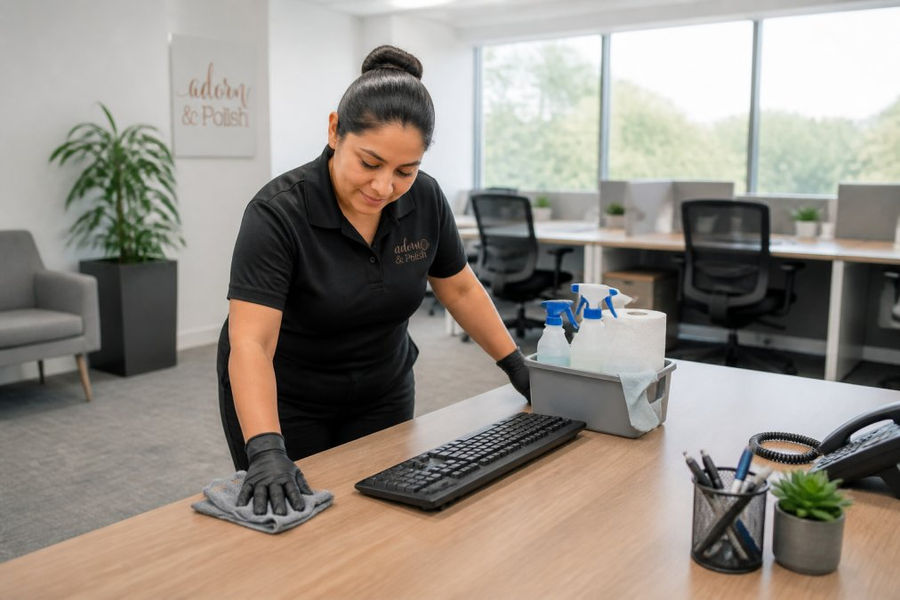
Professional cleaning reduces illness by targeting the surfaces people touch most, not just the surfaces people see. Desk keyboards, shared printers, door handles, and breakroom counters carry the highest germ loads in any office.
High-Traffic Areas and Cross-Contamination
Cross-contamination happens when one cloth moves from a restroom to a breakroom. Professional crews use color-coded cloths and separate tools per zone to stop that transfer. High-traffic areas get sanitized daily; low-touch surfaces follow a lighter schedule.
Indoor Air Quality and Occupational Health
Indoor air quality improves when vents, filters, and floor edges are maintained on a schedule. Dust and allergens collect there, and poor air quality shows up as headaches, allergies, and fatigue. Occupational health improves when cleaning addresses air and surfaces together, not just the visible layer.
Pro Tip Ask any cleaning provider how they prevent cross-contamination between restrooms and food areas. If the answer is vague, that tells you more than any brochure will.
Commercial Cleaning vs In-House Staff: Which Actually Saves You Money?
Commercial cleaning vs in-house staff usually comes down to total cost, not hourly wage. An in-house hire means salary, payroll taxes, benefits, training, equipment, and coverage during vacation or illness. A contract cleaning service folds all of that into one predictable line item.
Prime Bond Clean | Every Surface shine
Factor | In-House Staff | Contract Cleaning |
Cost structure | Salary, taxes, benefits | Fixed service agreement |
Coverage gaps | Vacation, sick days | Backup crew provided |
Equipment | You buy and maintain | Provider supplies |
Management load | You supervise daily | Handled by provider |
Specialized training | Your responsibility | Included |
Commercial Cleaning Cost Per Square Foot: What Drives Your Quote
Commercial cleaning cost per square foot varies widely, so treat any single number you see online with suspicion. A published national average is a starting point, not a quote. Your number depends on square footage, traffic levels, surface types, restroom count, and service frequency, two offices of identical size can land in very different ranges.
The Variables That Move Your Number
Frequency: Daily service costs more per month than weekly, but the per-visit rate is often lower because the crew is already in the building. Weekly-only service on a high-traffic floor means each visit is heavier and priced accordingly.
Occupancy density: Square footage alone is misleading. A 5,000-square-foot open office with 60 desks generates more touch-point labor than a 5,000-square-foot warehouse with 10 workstations.
Restroom count and fixture ratio: Restrooms are the most labor-intensive areas per square foot. The ratio of occupants to fixtures (toilets, urinals, sinks) drives restroom time more than raw square footage.
Surface mix: Carpet, hardwood, polished concrete, stone, and glass each require different products, tools, and dwell times. A floor plan heavy on hard surface and glass costs more than one dominated by low-pile carpet.
Add-on services: Deep cleaning, carpet extraction, window cleaning, and post-construction cleanup sit outside routine service and are quoted separately.
Access and after-hours timing: Buildings requiring badge escorts, freight-elevator scheduling, or overnight-only access add labor hours that show up in the rate.
How a Quote Actually Gets Built
A credible provider does not quote from a phone call. The standard process is a walkthrough, a task list, and a written scope. The estimator measures cleanable square footage (not gross), counts restrooms and fixtures, notes surface types, and asks about traffic patterns and after-hours constraints. That data feeds a labor-hour estimate, multiplied by the provider's loaded labor rate and combined with supply and equipment costs.
The ROI Framework: In-House vs. Outsourced
To compare an in-house hire against a contract proposal, build a total-cost figure rather than comparing an hourly wage to a monthly invoice. Add these line items on the in-house side:
Base wage × annual hours
Payroll taxes and workers' compensation
Benefits, paid time off, and holiday coverage
Training time and turnover cost (janitorial roles commonly see high annual turnover, meaning repeated hiring and onboarding)
Equipment purchase, maintenance, and supply restocking
Management time spent scheduling, supervising, and covering callouts
Watch Out The cheapest quote often excludes restroom sanitization, supply restocking, or periodic deep cleaning. When those get added later, the "budget" option usually costs more than the mid-range bid. Ask every bidder to confirm in writing which tasks are included and which are billed as add-ons.
Pro Tip Ask for the quote in two formats: a flat monthly figure and a per-visit figure. The flat figure protects your budget; the per-visit figure tells you what you are paying when you add a one-time deep clean before a client event.
Your Office Cleaning Checklist for Businesses: What a Professional Crew Actually Does
An office cleaning checklist for businesses should cover daily, weekly, and periodic tasks. If a provider cannot show you their checklist, you cannot hold them to a standard.
Daily tasks:
Empty and reline all waste and recycling bins
Wipe and disinfect high-touch points: handles, switches, shared keyboards
Clean and sanitize restrooms, restock paper and soap
Sweep, vacuum, and spot-mop all traffic lanes
Clean breakroom counters, sinks, and appliance exteriors
Weekly and monthly tasks:
Dust vents, ledges, and partition tops
Machine-scrub hard floors
Detail glass and entry doors
Deep clean breakroom appliances inside and out
Quarterly and seasonal tasks:
Carpet extraction
High dusting and light fixture cleaning
Floor stripping and waxing where applicable
First Impressions, Employee Morale, and the Productivity Payoff
First impressions form in seconds, and a clean lobby does quiet work before anyone speaks. Clients read a spotless entryway as a sign of a well-run operation; a cluttered, dusty space suggests the opposite, fairly or not.
Key Takeaway Professional cleaning is one of the few office investments that shows up in client perception, employee health, and staff morale at the same time.
Sustainability, Security, and Sanitation: What Smart Buyers Ask Before Signing
Most articles stop at "ask about green cleaning." That is not enough. Sustainability, security, and post-pandemic sanitation are where a bad answer costs you the most. Here is what to actually ask, and what a credible answer sounds like.
Sustainability: Certifications, Not Adjectives
"Eco-friendly" is a marketing word. Certifications are verifiable. Ask which third-party certifications a provider's products carry. The two most common in commercial cleaning are Green Seal (which certifies individual cleaning products against environmental and health criteria) and EPA Safer Choice (a U.S. Environmental Protection Agency program labeling products that meet its safer-chemistry standard). For the building itself, the LEED (Leadership in Energy and Environmental Design) rating system, administered by the U.S.
Ask these questions:
Which specific products does the crew use, and what certifications do they carry?
How is dilution controlled? Hand-mixed concentrates often get over-dosed, wasting product and increasing chemical residue.
Does the provider use microfiber systems? Microfiber removes more soil with less water and chemical than traditional mops and cloths.
How are waste and recycling streams handled, and does the provider support your building's diversion goals?
Security and Vetting: The Questions Corporate Buyers Forget
A cleaning crew has after-hours access to your offices, equipment, and often your documents. That makes vetting a security decision, not a formality. Ask:
Background screening: What does the check cover, criminal history, employment verification, identity confirmation? Is it run at hire only, or on a recurring basis?
Employment status: Are cleaners direct employees or subcontracted? Direct employment usually means the provider controls training and supervision; subcontracting can introduce accountability gaps.
Bonding and insurance: Is the company bonded and insured, and can they produce a certificate of insurance naming your building? Bonding protects against theft; liability insurance protects against damage.
Key and access handling: How are keys, fobs, and alarm codes stored and tracked? A written key-control log is standard for serious providers.
Data-adjacent areas: If cleaners enter spaces with files, servers, or whiteboards, what is the protocol? Are those areas cleaned by a smaller, designated crew?
Supervision: Who supervises the crew on site, and how often does a manager inspect the work?
Post-Pandemic Sanitation: Sanitizing vs. Disinfecting
These two words are not interchangeable. Sanitizing reduces germs on a surface to a level considered safe by public health standards (the CDC). Disinfecting kills or inactivates nearly all germs, but only if the product is applied correctly and left wet for the label's required dwell time. A crew that sprays and immediately wipes is sanitizing at best, regardless of what the bottle says.
Modern protocols also go beyond surfaces:
High-touch disinfection: Door handles, elevator buttons, shared keyboards, printer panels, and breakroom appliance handles get disinfected on a documented schedule, not just when they look dirty.
Air quality: Vent and filter maintenance, floor-edge cleaning, and HEPA vacuuming reduce dust and allergens that recirculate through a building. Ask how often vents and filters are serviced.
Documentation: A written protocol you can review beats a verbal promise. Ask for the task list, the frequency, and the product safety data sheets (SDS) for everything the crew uses.
Pro Tip Request the safety data sheets for the products a provider plans to use. Reputable companies share them without hesitation, and the SDS tells you the required dwell time, which is the number most crews get wrong.
Key Takeaway Sustainability, security, and sanitation are the three questions that separate a provider you can audit from one you have to trust. Ask them before you sign, and ask for the answers in writing.
Conclusion
Choosing a cleaning provider is a decision about health, perception, and your own time. Adorn & Polish offers background-checked and rigorously vetted cleaners, eco-friendly cleaning services, seamless online communication and booking, and cash-free secure online payment across the Washington Metro Area. If you want a workspace that stays genuinely clean without adding to your management load, get started with Adorn & Polish and book a cleaning that fits your schedule.
Frequently Asked Questions
How does professional office cleaning impact employee productivity?
A consistently clean workplace reduces the germs that cause common illnesses, which means fewer sick days and fewer people working at half speed. Employees also report higher morale when their environment is tidy and well-maintained. Professional office cleaners handle high-traffic areas and shared surfaces on a set schedule, so the workspace stays presentable and healthy without anyone on your team adding cleaning to their to-do list.
What are the primary health benefits of regular office sanitation?
Regular sanitization targets the surfaces people touch most: door handles, shared keyboards, break room counters, and conference tables. That routine cuts down on cross-contamination and helps reduce the spread of colds and flu. Professional crews also use industrial-grade equipment that reaches areas a quick wipe-down misses, which supports better indoor air quality and a healthier environment for everyone in the building.
How do professional cleaning services compare to in-house janitorial staff?
In-house staff means payroll taxes, benefits, training, supplies, equipment, and management time on top of wages. A contract cleaning service bundles those costs into one predictable fee and brings vetted, insured workers with professional-grade equipment. The trade-off is less direct control over daily staffing, which is why a clear service level agreement matters. For most small and mid-sized offices, outsourcing reduces the administrative burden and total cost.
What should be included in a standard office cleaning checklist?
A solid checklist covers trash removal, dusting of desks and common surfaces, vacuuming and mopping floors, restroom sanitization, break room cleaning, and disinfection of high-touch points like handles and light switches. Many contracts also include periodic deep cleaning for carpets and windows. Ask your provider to put the checklist in writing so you can verify the work and adjust the scope as your space changes.
Book a Cleaning


Comments