
Are Eco-Friendly Cleaners Actually Effective? A 2026 Guide

Table of Contents
Are Eco-Friendly Cleaners Actually Effective? What the Evidence Shows
How Eco-Friendly Cleaners Work
Natural vs. Conventional Cleaners: The Real Difference
Eco Friendly Cleaning Products That Work: What to Look For
EPA Safer Choice Label Explained: How to Spot Real Eco-Certification
The Greenwashing Checklist: 5 Red Flags to Avoid
Where Eco-Friendly Cleaners Struggle: Surface-Specific Performance
Safety and Health Benefits for Families and Pets
Environmental Impact: Chemical Residue, VOCs, and Your Home
How to Switch to Green Cleaning Products Without Losing Clean
The Verdict: When Eco-Friendly Cleaners Win and When They Don't
Frequently Asked Questions
Last Updated: October 2, 2026
Are Eco-Friendly Cleaners Actually Effective? What the Evidence Shows
Are eco-friendly cleaners actually effective? Yes, for the majority of everyday household cleaning tasks, plant-based and pH-neutral formulas remove soils, grease, and surface grime as well as conventional products when they are matched to the right surface and given adequate dwell time. The catch is that "eco-friendly" is a marketing term, not a performance standard, so effectiveness varies wildly between a certified product and a green-labeled bottle with no verification behind it.
At Adorn & Polish, we clean homes and commercial spaces across the Washington Metro Area, and our teams work with eco-friendly solutions daily. What we see in practice matches the research: green chemistry has closed most of the performance gap on routine cleaning, but not all of it. Below, we break down where these products win, where they fall short, and how to tell the difference before you buy.
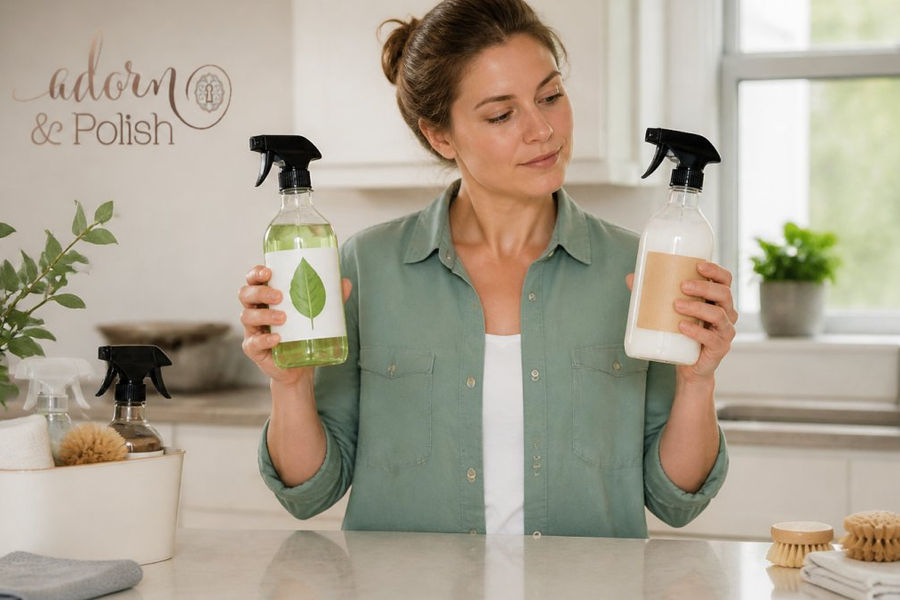
How Eco-Friendly Cleaners Work
Eco-friendly cleaners rely on biodegradable surfactants, plant-based solvents, and pH-neutral formulations to lift soil rather than dissolve it with harsh synthetics. Instead of volatile organic compounds and chlorine-based agents, they use citric acid, vinegar derivatives, and enzyme blends that break down grease and organic matter.
The tradeoff is dwell time. Conventional cleaners often act on contact; green formulas frequently need a minute or two to work. Give them that time and most kitchen counters, bathroom fixtures, and floors come clean without residue.
Natural vs. Conventional Cleaners: The Real Difference
The real difference comes down to what's left behind. Conventional cleaners may leave chemical residue that off-gasses into indoor air, while natural formulas break down into harmless compounds after use. That distinction matters more for indoor air quality than for raw cleaning power.
A common mistake is assuming "natural" means "weak." Well-formulated plant-based cleaners handle grease, soap scum, and everyday pathogens effectively. What they typically lack is the aggressive bleaching and disinfecting action of chlorine or quaternary ammonium products, which is a meaningful gap in specific settings.
Eco Friendly Cleaning Products That Work: What to Look For
The eco friendly cleaning products that work share a few traits: transparent ingredient lists, third-party certification, concentrated formulas, and a stated pH range. Fragrance-free and hypoallergenic options reduce the risk of skin and respiratory irritation.
Look for these markers on the label:
Full ingredient disclosure, not just "plant-based surfactants"
A recognized ecolabel or eco-certification seal
Concentrated formula (less packaging, less water shipped)
pH-neutral or mildly alkaline for general surfaces
Safety data sheets available on request
Ingredient transparency is the single best predictor of quality. Companies confident in their formulation list everything. Companies hiding behind vague terms usually have something to hide.
EPA Safer Choice Label Explained: How to Spot Real Eco-Certification
The EPA Safer Choice label is a voluntary US Environmental Protection Agency program that reviews every ingredient in a product for human health and environmental safety before allowing the seal. It is one of the few ecolabels in the United States backed by government toxicology review rather than self-certification.
When you see the Safer Choice mark, the product has passed ingredient-level screening for both cleaning performance and safety. That combination is why it carries more weight than a brand's own "green" badge.
The Greenwashing Checklist: 5 Red Flags to Avoid
Greenwashing is when a product markets itself as eco-friendly without verifiable environmental or health claims behind it. Use this checklist to screen products fast:
Vague terms like "natural," "pure," or "eco" with no certification
No full ingredient list on the label or website
A green leaf logo that is the company's own design, not a third-party seal
"Chemical-free" claims (everything is a chemical, including water)
No safety data sheets or toxicology information available
If a product fails two or more of these, treat the green claim as marketing rather than substance.
Where Eco-Friendly Cleaners Struggle: Surface-Specific Performance
Surface-specific efficacy testing shows that green cleaners perform differently across materials, and the reason comes down to chemistry rather than brand quality. Three variables decide whether a plant-based formula wins or fails on a given surface: pH, surfactant type, and whether the soil is mineral or organic.
Here is how that plays out surface by surface.
Sealed granite and quartz. These surfaces have a factory-applied seal that resists water and oil. A pH-neutral green cleaner with nonionic surfactants lifts fingerprints, food film, and light grease without dulling the seal. Avoid acidic formulas here only if the seal is worn; on a healthy seal, mild citric-acid cleaners are fine. The failure mode is abrasive pads, not the cleaner.
Marble, travertine, and limestone. These are calcium carbonate stones. Any acid, including vinegar and citric acid, reacts with the calcium and etches the surface, leaving a dull ring that no cleaner can reverse. This is the single clearest case where a green staple (vinegar) is the wrong tool. Use a pH-neutral stone cleaner and a microfiber cloth.
Stainless steel. The enemy is not soil, it is residue. Oil-based polishes and high-surfactant formulas leave streaks and smear the grain. A green cleaner diluted with water and wiped with the grain works; a vinegar-and-water mix also works but can pit lower-grade steel over repeated use. Dry immediately to prevent water spots.
Glass and mirrors. Vinegar-based formulas excel because acetic acid dissolves the mineral film that tap water leaves behind. The tradeoff is smell and the risk of damaging window frames or stone sills if overspray is not wiped. A 1:1 vinegar-to-water mix is the common home ratio.
Grout and tile. This is where green cleaners most often lose. Grout is porous and holds both organic soil (soap scum, body oils) and mineral soil (hard-water calcium).
Pro Tip Keep two green cleaners on hand: a pH-neutral all-purpose spray for the majority of surfaces, and a mildly alkaline degreaser for kitchen grease. Add a dedicated stone-safe formula if you have marble or travertine. That trio covers nearly every residential task without reaching for harsh synthetics.
Safety and Health Benefits for Families and Pets
The safety case for eco-friendly cleaners is where the evidence is strongest. Reduced exposure to volatile organic compounds, synthetic fragrances, and harsh surfactants lowers human health risks, particularly for children, pets, and anyone with asthma or allergies.
Environmental Impact: Chemical Residue, VOCs, and Your Home
Environmental impact starts indoors. Volatile organic compounds released by conventional cleaners contribute to indoor air pollution, and chemical residue washed down drains eventually reaches waterways. Biodegradable formulas break down instead of accumulating.
How to Switch to Green Cleaning Products Without Losing Clean
Switching works best as a gradual swap rather than a purge. Replace one product category at a time, starting with the surfaces you clean most often, and keep a conventional disinfectant on hand for high-risk situations.
Follow this sequence:
Start with all-purpose spray. It covers the most surface area with the least risk.
Add a green glass cleaner. Vinegar-based formulas handle streaks well.
Swap bathroom cleaners next. Look for a certified descaler for soap scum.
Keep one EPA-registered disinfectant. Use it only where germs, not grime, are the concern.
Read every label. Certification beats packaging color every time.
The Verdict: When Eco-Friendly Cleaners Win and When They Don't
Eco-friendly cleaners win on routine cleaning, indoor air quality, and household safety. They win on countertops, glass, floors, and fixtures. They win for families with kids, pets, and allergy concerns.
Situation | Eco-Friendly Cleaner | Conventional Cleaner |
Daily counters and glass | Effective | Effective |
Kitchen grease | Effective with dwell time | Faster acting |
Natural stone | Use pH-neutral only | Risk of etching |
Germ disinfection | Only if EPA-registered | Broad options |
Homes with pets or kids | Preferred | Higher residue risk |
Frequently Asked Questions
Are eco-friendly cleaners as effective as conventional chemical cleaners?
For routine cleaning like dust, light grease, and everyday messes, eco-friendly cleaners perform comparably to conventional options. The difference shows up with heavy-duty tasks. Plant-based surfactants and pH-neutral formulas may need a longer dwell time or a second pass on baked-on grease or soap scum. For disinfection, check whether the product carries an EPA registration, since not all green cleaners are registered disinfectants.
What are the best non-toxic cleaners that actually clean effectively?
Look for products with the EPA Safer Choice label, full ingredient transparency, and concentrated formulas. Effective eco-friendly cleaners typically list specific surfactants rather than vague terms like 'plant-based blend.' For kitchens and bathrooms, a pH-neutral all-purpose cleaner handles most surfaces, while a citric-acid-based product works well on mineral deposits. Always match the cleaner to the surface to avoid damage.
How can you tell if a natural cleaning product is actually working?
Visible results matter: surfaces should be free of residue, streaks, and sticky film after drying. For microbial load, use an EPA-registered disinfectant if you need verified bacterial reduction. If a product claims to disinfect but lacks an EPA registration number, it is not a verified disinfectant. You can also check whether the manufacturer publishes safety data sheets and third-party test results.
Are there specific surfaces where green cleaners struggle?
Eco-friendly cleaners can struggle on porous stone like marble or travertine if the formula is acidic, on heavy soap scum in showers without enough dwell time, and on greasy range hoods where stronger surfactants are needed. Always test on a small area first. For these surfaces, look for surface-specific products or extend the contact time before wiping.
Most people don't have time to test every green product against every surface in their home. Adorn & Polish takes that off your plate with background-checked cleaners, eco-friendly solutions, and a seamless online booking process built for busy households and property managers across the Washington Metro Area. Get started with Adorn & Polish and enjoy a sparkling, immaculate space without the guesswork.
Book a Cleaning


Comments