
Best Eco Friendly Home Cleaning Products for 2026

Table of Contents
What Makes a Cleaning Product Truly Eco Friendly?
Top Non-Toxic Cleaning Supplies for Home Use
The Benefits of Eco-Friendly House Cleaning for Your Family
Indoor air quality and the VOC load
Pet-safe and child-safe verification
Greywater system compatibility
The environmental side
How to Choose Green Cleaning Products That Actually Work
All-Purpose Cleaners, Dish Soaps, and Laundry Essentials
All-purpose cleaners
Dish soaps
Laundry detergents and hard water
Refill systems: the lifecycle question
Ingredients to Avoid in Household Cleaners
DIY Homemade Cleaning Solutions vs. Store-Bought Options
Frequently Asked Questions
Last Updated: September 17, 2026
What Makes a Cleaning Product Truly Eco Friendly?
A cleaning product is truly eco friendly when its ingredients break down safely, its packaging creates minimal waste, and it cleans as well as conventional options without leaving toxic residue. That combination matters more than any label.
Biodegradable ingredients that break down in wastewater instead of persisting in waterways
Plant-based surfactants that lift grease without petroleum derivatives
Refillable or plastic-free packaging that cuts packaging waste at the source
Key Takeaway Eco-friendly cleaning isn't about one miracle product. It's about ingredient transparency, safe breakdown, and packaging that doesn't outlive you.
Top Non-Toxic Cleaning Supplies for Home Use
The most reliable non-toxic cleaning supplies for home fall into four categories: an all-purpose cleaner, a dish soap, a laundry detergent, and a disinfectant. You don't need twenty bottles. You need four that work.
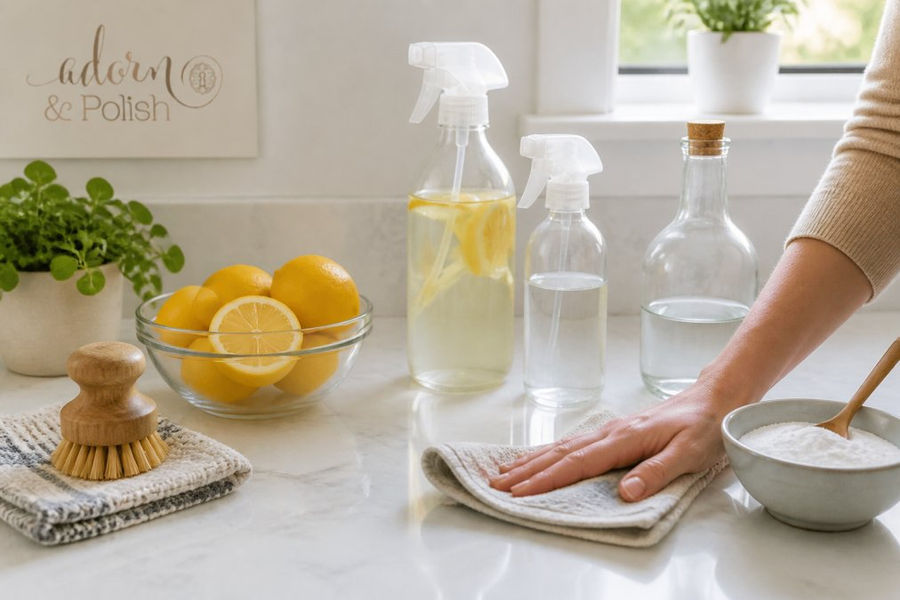
Here's what to look for in each:
All-purpose cleaner: plant-based surfactants, no synthetic fragrance, concentrated formula so one bottle lasts months
Dish soap: biodegradable, cruelty-free, cuts grease without leaving film on glassware
Laundry detergent: concentrated, phthalate-free, works in cold water to lower your carbon footprint
Disinfectant: look for plant-based options that meet EPA registration for disinfection, since "natural" alone doesn't kill pathogens
The Benefits of Eco-Friendly House Cleaning for Your Family
The benefits of eco-friendly house cleaning come down to two things: fewer airborne chemicals indoors and less environmental impact outside. But the benefits most guides skip are the ones families ask about: safety around kids and pets, and safety for greywater systems.
7 eco-friendly cleaning products for a sustainable home
TMS | Global Entertainment
Indoor air quality and the VOC load
Indoor air quality is the underrated argument. Conventional cleaners can release volatile organic compounds (VOCs), which build up in closed rooms and linger on surfaces where children and pets spend time. The American Lung Association's guidance on cleaning and indoor air recommends choosing fragrance-free products and ventilating while you clean, because even mild cleaners release fumes in closed rooms. That's practical advice, not alarmism.
Pet-safe and child-safe verification
"Non-toxic" is not a regulated safety claim for household cleaners. Here's how to verify safety for the two groups most sensitive to residue: infants and pets.
Look for full ingredient disclosure. A cleaner that lists every ingredient earns more trust than one that hides behind "proprietary blend." Undisclosed fragrance is the most common hiding place for phthalates.
Check for EPA Safer Choice certification. The EPA Safer Choice program verifies products against a published ingredient safety standard, which is a stronger signal than a company's own "pet safe" badge.
Treat "pet safe" as a marketing term, not a standard. No federal agency certifies cleaners specifically for pet safety. The practical test is ingredient transparency plus a fragrance-free formula, since fragrance is the most common irritant for cats and dogs.
Rinse food-contact and pet-bowl surfaces. Even plant-based surfactants leave residue. A clean water rinse after wiping removes the film that pets lick off floors and bowls.
Greywater system compatibility
If your home routes sink and shower water to garden irrigation, your cleaner becomes irrigation water. Greywater-safe products must be biodegradable and free of boron, chlorine, and salts that harm soil and plants, not every green cleaner qualifies.
Avoid chlorine bleach and borax. Both are common in conventional and some "natural" cleaners, and both damage soil biology.
Watch the sodium. Many plant-based surfactants are sodium-based, and repeated greywater irrigation can build up sodium in soil over time.
Check the pH. Highly alkaline cleaners can shift soil pH; mild or neutral formulas are safer for irrigation.
Verify before you irrigate. A product can be biodegradable and still not greywater safe. Check the ingredient list for boron, chlorine, and salts before you connect a cleaning routine to a garden.
The environmental side
Biodegradable ingredients break down in wastewater treatment instead of accumulating in rivers. Refillable systems cut plastic waste, but a refill only lowers your footprint if you actually reuse the bottle and it ships efficiently, single-use pouches traveling long distances can offset the savings.
Watch Out Don't assume "refillable" automatically means low-waste. If the refill arrives in a plastic pouch you toss after one use, you've swapped one bottle for another. Reusable glass or concentrated tablets do far more.
Key Takeaway The strongest family benefit isn't a label, it's verified ingredient disclosure, fragrance-free formulas, and a quick greywater check before you send anything down the drain.
How to Choose Green Cleaning Products That Actually Work
Choosing green cleaning products that actually work means ignoring the front label and reading the back. Certification and ingredient lists tell you more than any "eco" badge.
Then scan the ingredient list for what's missing:
No synthetic fragrance (a common source of VOCs)
No phthalates or parabens
No chlorine bleach if you have septic or greywater concerns
A concentrated formula, which means less water shipped per clean
Pro Tip The real difference between a cleaner that works and one that doesn't usually comes down to dwell time, not the formula. Spray, then wait a full minute before wiping. Most "weak" green cleaners were simply wiped off too fast.
All-Purpose Cleaners, Dish Soaps, and Laundry Essentials
For most homes, three products cover nearly everything: an all-purpose cleaner, a dish soap, and a laundry detergent. Get these right and you rarely need specialty sprays, but that means matching the formula to your surfaces and water, not just buying the greenest bottle.
All-purpose cleaners
An all-purpose cleaner handles counters, sinks, and most hard surfaces. Look for plant-based surfactants and no synthetic fragrance; concentrated versions cost more upfront but last far longer.
Glass and mirrors: a vinegar-and-water spray works, but skip it on natural stone. Acid etches marble and travertine.
Wood: use a damp cloth with a mild, pH-neutral cleaner. Excess water and alkaline formulas dull finishes.
Tile and grout: baking soda paste handles soap scum and mild scrubbing; a plant-based surfactant spray handles the tile face.
Sealed stone: avoid acidic cleaners entirely. Look for a pH-neutral, stone-safe formula.
Dish soaps
Dish soap is where degreasing gets tested daily. Plant-based formulas have caught up on grease but need more elbow grease on baked-on residue. A drop of vinegar in the rinse water helps cut soap scum on glassware.
Laundry detergents and hard water
Laundry detergent is the quiet workhorse. Concentrated, phthalate-free formulas clean well in cold water, which lowers energy use and carbon footprint. The catch is hard water: minerals bind to detergent and reduce performance, which is why eco formulas sometimes seem to "fail" in high-mineral areas when the water is the real problem.
Add a laundry booster or a splash of white vinegar to the rinse cycle to help counteract mineral buildup.
Use the right dose. More detergent does not fix hard water; it leaves residue. Follow the label and adjust for water hardness.
Check your water report. Your utility publishes water hardness, usually in grains per gallon. If you're above roughly 7 grains per gallon, expect to need a booster.
Refill systems: the lifecycle question
Refillable systems are the most-hyped eco upgrade and the most misunderstood. A refill only reduces your footprint if you actually reuse the bottle and the refill ships efficiently.
Concentrated tablets ship light and small, which cuts shipping emissions per clean. They're the strongest refill format on lifecycle grounds.
Water-heavy liquid refills ship mostly water. If they travel long distances in single-use plastic pouches, the savings shrink or disappear.
Local bulk buying, refilling at a store with your own container, often beats mail-order refills on emissions because there's no shipping leg at all.
Product | Key Ingredient to Look For | Best For | Watch Out For |
All-purpose cleaner | Plant-based surfactants | Counters, sinks, hard surfaces | Synthetic fragrance; acid on stone |
Dish soap | Biodegradable, cruelty-free formula | Greasy dishes, glassware | Weak soap scum removal |
Laundry detergent | Concentrated, phthalate-free | Everyday laundry, cold wash | Poor hard water performance |
Disinfectant | EPA-registered plant-based formula | High-touch areas, illness season | Unverified "kills germs" claims |
Key Takeaway Match the formula to the surface and the water, not just the label. Concentrated tablets and local bulk refills beat water-heavy mail-order pouches on lifecycle grounds every time.
Ingredients to Avoid in Household Cleaners
The ingredients to avoid in household cleaners are those linked to indoor air problems and environmental harm. You don't need a chemistry degree to spot them, just a habit of reading labels.
Volatile organic compounds (VOCs): contribute to indoor air pollution and can irritate airways
Synthetic fragrance: often hides phthalates and other undisclosed chemicals
Chlorine bleach: effective but harsh, and a problem for septic and greywater systems
Parabens and phthalates: common preservatives and fragrance carriers worth avoiding
Petroleum-based surfactants: slower to biodegrade than plant-based alternatives
DIY Homemade Cleaning Solutions vs. Store-Bought Options
DIY homemade cleaning solutions win on cost and control; store-bought options win on convenience and verified performance. Most homes benefit from a mix of both.
Frequently Asked Questions
What are the best eco-friendly cleaning products for deep cleaning?
For deep cleaning, look for concentrated formulas that use plant-based surfactants and oxygen-based bleach instead of chlorine. Products with citric acid handle soap scum removal well, while those with enzymes break down grease and organic matter. Check for third-party certifications like Safer Choice or Green Seal. For tough jobs, a paste of baking soda and water works on grout, and a vinegar solution cuts through hard water stains. Always test on a small area first, especially on natural stone.
Are plant-based cleaning products as effective as traditional chemicals?
Plant-based cleaners can match traditional products when formulated correctly. The key is the surfactant system and concentration. Modern green cleaners often use coconut-derived surfactants that lift dirt and grease effectively. For disinfection, plant-based options with citric acid or hydrogen peroxide work against many household germs, though they may need longer dwell time. For heavy degreasing, you might need a bit more elbow grease or a second application. Many users find they work just as well for daily cleaning without the harsh fumes.
What ingredients should I avoid in household cleaning products?
Avoid products containing volatile organic compounds (VOCs), synthetic fragrances, phthalates, parabens, and chlorine bleach. Also watch for quaternary ammonium compounds (quats), which can irritate airways, and 2-butoxyethanol, a common solvent linked to respiratory issues. Check labels for vague terms like 'fragrance' or 'surfactants' without specifying plant-based sources. Instead, look for biodegradable, cruelty-free, and phthalate-free claims. The EPA's Safer Choice label helps identify products with safer ingredients.
How does Adorn & Polish ensure eco-friendly standards in their services?
Adorn & Polish uses non-toxic, biodegradable cleaning solutions that are safe for children, pets, and greywater systems. Their team is trained on proper dilution and application to maximize cleaning efficacy while minimizing environmental impact. They also use microfiber cloths and refillable bottles to reduce packaging waste. For clients with specific sensitivities or hard water concerns, they can adjust the product lineup. You can book a cleaning online and specify any preferences during scheduling. The real challenge with eco-friendly cleaning isn't finding products. It's finding the time to research certifications, mix solutions, and stay consistent week after week. Adorn & Polish handles that for you with eco-friendly cleaning services, background-checked and rigorously vetted cleaners, and seamless online booking with cash-free secure payment. Get started with Adorn & Polish and enjoy a sparkling, immaculate home without the guesswork.
Book a Cleaning


Comments